Island guide · the Ionian islands
Kefalonia Travel Guide: Is Kefalonia Right for You?
Kefalonia is for couples and road-trippers who want big scenery and real Greece, not for car-free or party travelers. Honest guide to where, when and how.
Kefalonia at a glance
Go if: Couples · Road-trippers · Families with older kids · Scenery lovers · Sailors
Skip it if: Nightlife · Car-free travelers · Anyone who hates mountain roads
Getting there: Kefalonia Airport (EFL) has direct summer flights from the UK and northern Europe plus year-round flights from Athens, or take the ferry from Kyllini to Poros (about 1.5 hours).
Kefalonia is right for you if you want big, wild scenery, a car, and a holiday that feels like Greece rather than a resort. It is not right for you if you want to walk everywhere, party, or tick off sights in a compact area: this is the largest island in the Ionian and everything is a drive.
Kefalonia at a glance
- Island group: Ionian Islands
- Getting there: Kefalonia Airport (EFL), 8 km south of Argostoli. Ferries: Kyllini to Poros about 1.5 hours, Patras to Sami about 3 hours, Astakos to Sami about 2.5 hours; seasonal boats from Lefkada (Vasiliki to Fiskardo, about 1 hour) and Zakynthos
- Best for: Couples, road-trippers, families with older kids, scenery lovers, sailors
- Not for: Nightlife, car-free travelers, anyone who hates mountain roads
- Best months: Late May to early July and September
- Price level: Mid
- Size & getting around: About 780 sq km with a 1,600 m mountain in the middle. A car is essential; scooters are only sensible locally
Who Kefalonia is for
Kefalonia rewards people who like to drive and explore. The island is big enough that every day can look different: white cliffs at Myrtos in the morning, a cave lake at Melissani after lunch, a Venetian fishing harbor at Fiskardo for dinner. The roads are good and the views from them are ridiculous.
Couples do well here. Assos and Fiskardo in the north are the two prettiest villages in the Ionian, with pastel houses that survived the 1953 earthquake, sailing yachts moored along the quay and a slow, grown-up atmosphere.
Families with children old enough to handle 40-minute drives get caves, boat trips to Ithaca and sandy beaches on the Paliki peninsula.
Who should skip Kefalonia
If you want to arrive, drop the bags and never think about transport again, Kefalonia will frustrate you. Argostoli is a working town rather than a resort, the best beaches are 30 to 60 minutes from wherever you are staying, and the bus service is skeletal. Nightlife amounts to a few bars in Argostoli and Lassi; anyone after clubs should go to Zakynthos or Mykonos.
It is also not a budget island in high season. Rooms in Fiskardo and Assos are scarce and pricey, and August car hire is expensive because everyone needs one.
What to actually do on Kefalonia
Myrtos Beach
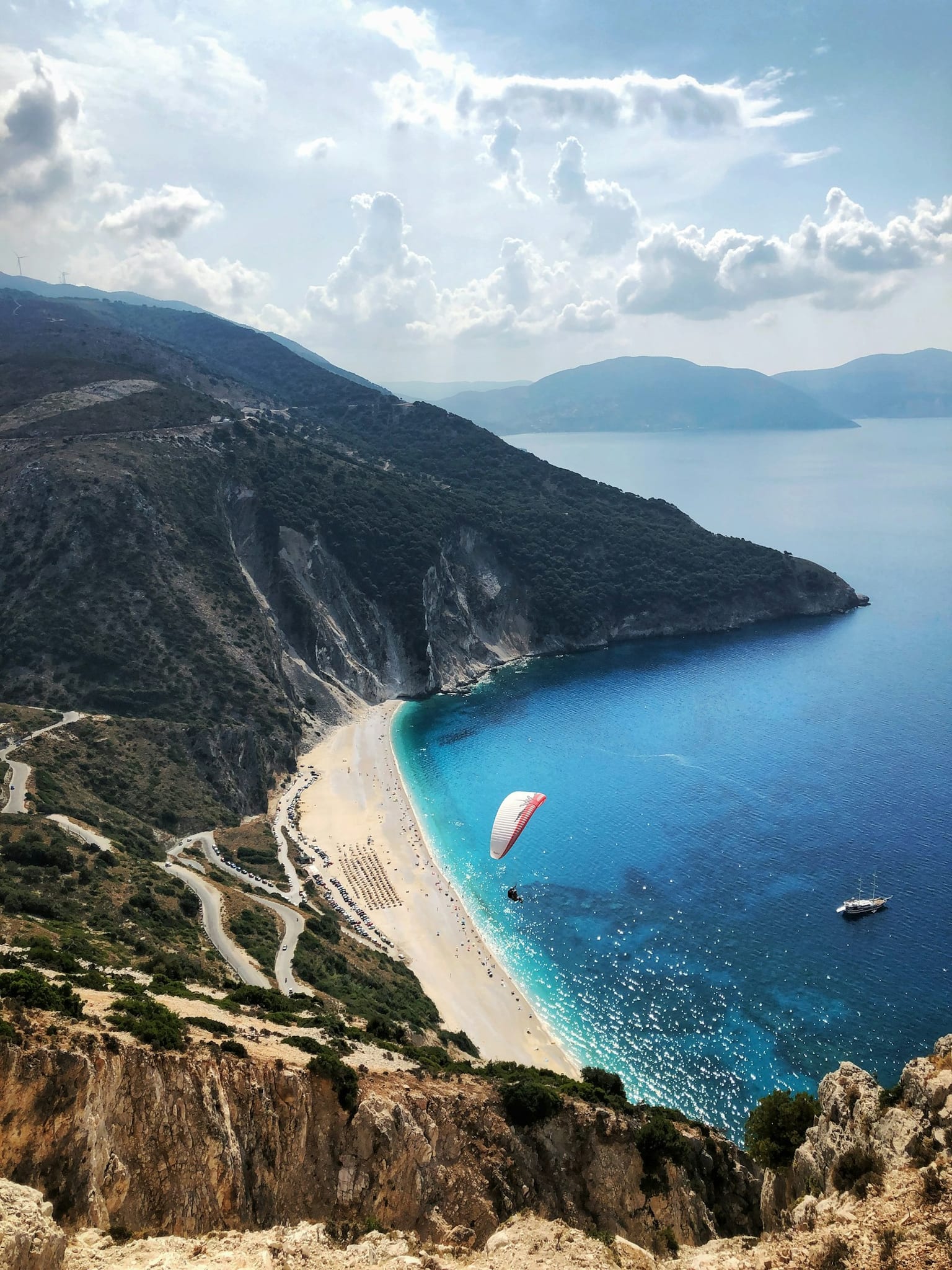
The one on every poster: a long crescent of white pebbles under 500-meter cliffs. Go before 10 am or after 5 pm in summer, and respect the undertow on windy days. The viewpoint on the road above is arguably better than the beach itself.
Melissani and Drogarati caves
Melissani, just outside Sami, is a collapsed cave with a lake in it; when the sun is overhead around midday the water turns electric blue. Drogarati, nearby, is a big stalactite cave. Combine both with a swim at Antisamos.
Fiskardo and Assos
Fiskardo is the yachting village at the northern tip, expensive and polished but genuinely lovely, with a short walk through cypress woods to the Venetian lighthouse. Assos, 20 km south, sits on a tiny isthmus below a Venetian castle; walk up in 30 minutes and swim at the village beach afterwards.
The Paliki peninsula
Take the 20-minute ferry from Argostoli to Lixouri and you get a quieter, flatter Kefalonia: red sand at Xi, the vertical cliffs and turquoise water of Petani, and almost no tour buses.
Wine and Mount Ainos
Robola is Kefalonia’s own white grape, grown on the limestone slopes of Mount Ainos, and the cooperative and small wineries around Omala pour it by the glass. Ainos itself is a national park with a road to near the 1,628 m summit and a fir forest found nowhere else.
Where to stay on Kefalonia
- Argostoli and Lassi: the capital and its beach suburb; best for first-timers who want restaurants, the airport nearby and a central base for day trips.
- Fiskardo and Assos: the north, for couples with a bigger budget who want charm and are happy to drive to beaches.
- Skala and Poros: the southeast, with long beaches and the Kyllini ferry; better value and more family-oriented.
- Lixouri and the Paliki: for a slower, less touristy stay near Xi and Petani.
When to go
June and September are ideal: 26 to 30 C, sea around 23 to 25 C, everything open and the roads empty. July and August are hot but not unbearable, and because the island is so big it absorbs crowds better than Zakynthos or Corfu. Kefalonia is sheltered from the Cycladic meltemi; afternoon breezes on the west coast are normal but not disruptive. May is green with a cool sea. From late October the north shuts down and winter brings serious rain, which is why the island is so green.
Getting there and around
Kefalonia Airport has direct summer flights from the UK, Ireland, Germany, Italy, the Netherlands, Austria, Switzerland, Scandinavia and Poland, and year-round flights from Athens. By ferry, the easiest mainland route is Kyllini to Poros, about 1.5 hours, with buses from Athens to Kyllini; Patras to Sami takes around 3 hours. In summer there are boats from Vasiliki on Lefkada to Fiskardo, and Ithaca is 20 minutes from Sami.
Book a car for the whole stay. Argostoli to Fiskardo is 50 km and takes about an hour and a quarter on a winding but well-kept road; Argostoli to Skala is 40 km. The bus is useless for beaches.
Kefalonia vs the alternatives
Zakynthos is smaller, cheaper and easier for a no-effort beach week, but far more built up. Lefkada has better beaches and no airport of its own, so you fly into Preveza and drive across the causeway. Corfu wins on history and food, loses on wild scenery. For a wider view, read our guide to the best Greek islands for couples.
Booking Kefalonia
The links below are affiliate links: we earn a commission if you book, at no extra cost to you. They change nothing about what this guide says. See how we make money.
- A car: Kefalonia is big and its best parts — Myrtos, Assos, Fiskardo — are spread along mountain roads. Do not come without one. Localrent.
- Flights: Kefalonia (EFL) takes direct summer flights from the UK and northern Europe. Compare fares on Aviasales.
Still not sure? Take the 2-minute Greek island quiz and we will tell you whether Kefalonia or one of its neighbors fits you better.
Also in the Ionian islands
Not sure yet? Take the 2-minute quiz
Frequently asked questions
Is Kefalonia expensive?
Mid-range. Fiskardo is priced for yacht owners; Skala, Poros and Lixouri are noticeably cheaper.
How many days do you need in Kefalonia?
A week is the minimum to do it justice because of the distances. Ten days lets you split your stay between the south and the north and add a day on Ithaca.
Do you need a car in Kefalonia?
Yes. It is the one Ionian island where a car is non-negotiable. Beaches, caves and villages are spread over 780 sq km and the bus will not get you to most of them.
Last updated 2026-09.