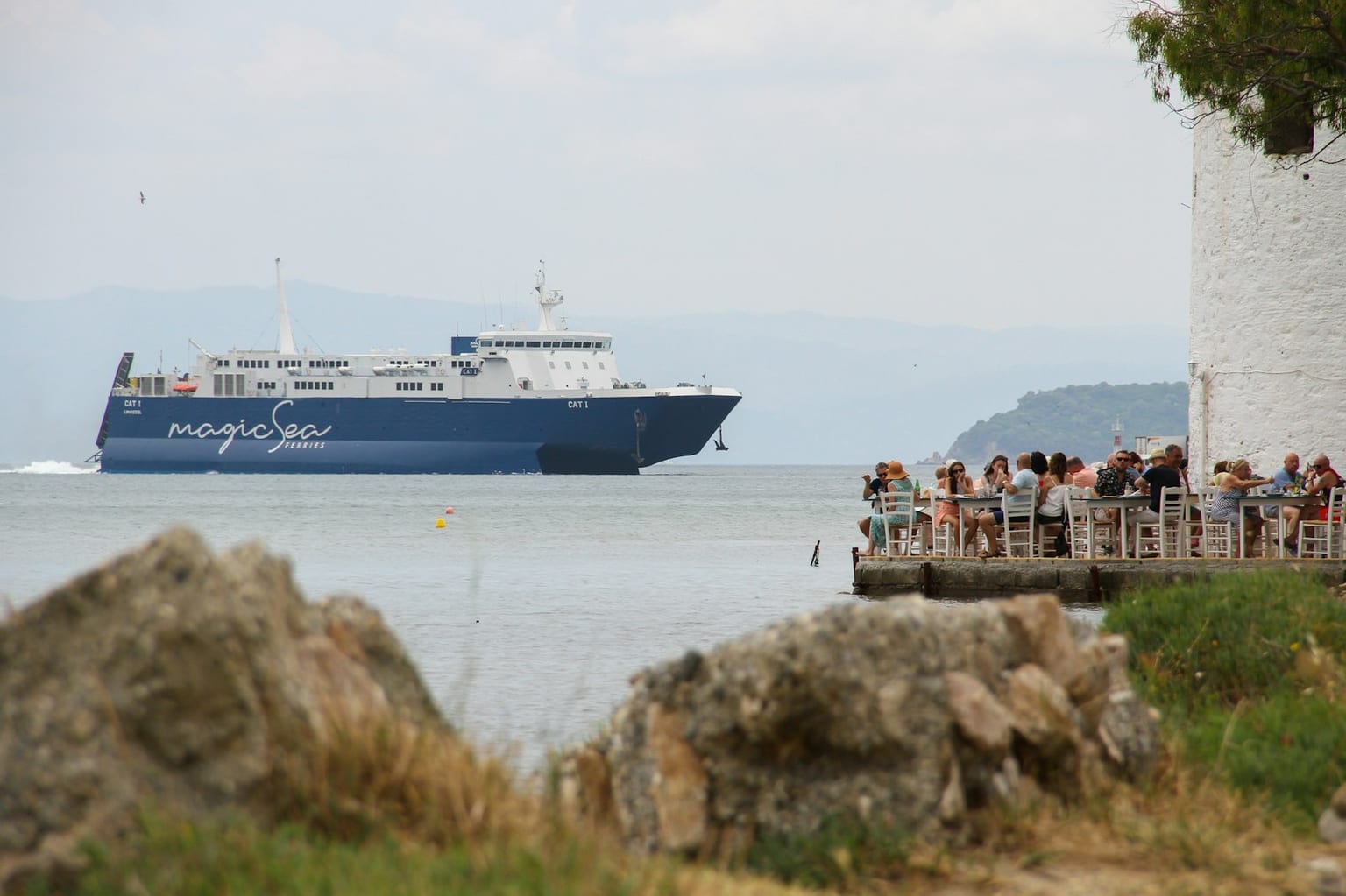
Guide
Greek Island Ferries: How They Actually Work
Which Athens port, fast ferry or conventional, when to book, and what happens when the meltemi cancels your sailing. The practical guide to Greek ferries.
Almost everything that goes wrong on a Greek island holiday goes wrong at a ferry port. People book the wrong port, assume two islands connect when they do not, buy the expensive boat when the cheap one is an hour slower and far more pleasant, or fly home the same day they sail — and lose the flight to a wind that blows every August. None of it is complicated. It is just never explained.
This is the practical version: which port, which boat, when to book, and what actually happens when the sea gets rough.
Athens has three ferry ports, not one
This is the single most common mistake. Piraeus and Rafina are on opposite sides of Athens, roughly an hour apart, and both serve the Cyclades. Check which one is on your ticket before you get in a taxi.
| Piraeus | Rafina | Lavrio | |
|---|---|---|---|
| Goes to | Nearly everywhere: Cyclades, Dodecanese, Crete, North Aegean, Saronic Gulf | Andros, Tinos, Mykonos, and on to Paros, Naxos, Santorini | Mostly Kea and Kythnos, plus a weekly link to Lemnos |
| From Athens airport | Metro Line 3 direct, about 60–65 minutes, €9. Or the X96 bus, €5.50, allow 90 minutes | KTEL bus, 30–40 minutes, around €3–4. Taxi 20–30 minutes | No direct bus — KTEL with a change at Markopoulo, and a sparse daytime-only service |
| Best for | Almost every island, and the only sensible choice for Santorini, Milos, Sifnos, Serifos, Naxos and the Small Cyclades | Andros (the only option), Tinos and Mykonos — the crossing is genuinely shorter | Kea, and little else |
| Watch out for | The port is 3 km long with gates E1 to E12 — allow time to find yours | No metro. More exposed to wind, and fewer fallback sailings when one is cancelled | Awkward to reach without a car |
If you land late, arrive with children, or have a tight connection to a morning boat, a pre-booked transfer removes the one variable you cannot control. Welcome Pickups meets you in arrivals with a fixed price to Piraeus or Rafina — useful at Rafina in particular, where the bus timetable does not always match the sailing. (Affiliate link; see how we make money.)
Is Rafina really faster? For the northern Cyclades, yes. A fast ferry from Rafina reaches Mykonos in a little over two hours; from Piraeus it is closer to two hours forty. Add the shorter airport run and Rafina saves you a real hour to Mykonos, Tinos or Andros.
But Rafina is more exposed to the summer wind, and when sailings are stopped there they tend to be stopped completely. On 14 August 2026 the port authority banned all departures from Rafina and Lavrio, while Piraeus lost only selected sailings. Piraeus has the metro, the most departures and the most alternatives if your boat is cancelled. For anything south or west — Santorini, Milos, Sifnos, Folegandros — Piraeus is simply where the boats are.
Fast ferry or conventional?
Most people reflexively book the fast one. Often that is the worse trip.
| Conventional ferry | High-speed catamaran | |
|---|---|---|
| Price | The cheap option. Piraeus to Santorini from around €50 | Considerably more — often close to double |
| Speed | Piraeus to Santorini 5.5 to 7.5 hours depending on stops | As little as about 5 hours to Santorini, 3h15 to Naxos |
| Outside deck | Yes. Open decks, sea air, the arrival view | No. You are indoors for the whole crossing |
| Seating | Deck class, numbered airseats, cabins on long routes | Assigned airline-style seats only |
| If you get seasick | Bigger, steadier, and you can go outside | Worse: faster, smaller, sealed in |
| In wind | More likely to sail | Cancelled first, and cancelled earliest |
The time saving is usually smaller than the price gap suggests. On Athens to Santorini, some conventional sailings take only about an hour longer than the fastest catamaran, for roughly half the money, with a deck you can stand on and the caldera coming into view as you arrive. If you want one recommendation: book a numbered airseat on a Blue Star ferry. You get a reserved seat and the deck, which is the best of both.
Take the fast boat when the day matters more than the money — a short trip, a tight connection, or a crossing with young children who will not last seven hours.
The meltemi: the wind that decides your summer
The meltemi is a dry northerly that blows across the Aegean from June to September and peaks in July and August. It hits the Cyclades hardest, and within the Cyclades it hits Mykonos, Tinos and Andros hardest of all — exactly the Rafina corridor. At its worst it gusts to force 7 or 8.
The useful part, which almost nobody tells you: the meltemi follows a daily rhythm. It builds through the morning, blows hardest from late morning to sunset, and eases in the evening. An early-morning or evening sailing is meaningfully more likely to run than a midday one. If you have a choice of departure times in August, take the first boat.
What “cancelled” actually means
- A port-wide ban. The port authority stops everything. Nothing sails, from any operator.
- Selective cancellations. Individual sailings are pulled while others run. Note that this hits conventional ferries too — the idea that big boats always sail is not true.
- A changed route. The ferry departs but reorders or skips port calls depending on what it finds. Your island can be the one that gets skipped. Check before you board if the weather is marginal.
Your rights if it happens
Under EU passenger rights (Regulation 1177/2010), if your sailing is cancelled or delayed more than 90 minutes at departure, the operator must offer you a choice: a full refund within seven days, or re-routing to your destination at no extra cost. That part is solid.
What you do not get is compensation, and usually not a hotel either: both the delay compensation and the accommodation obligation fall away when the cause is severe weather. A meltemi cancellation is weather. In practice you get your money back or another boat, and the extra night is yours to pay for.
Which leads to the one rule worth following religiously: get back to Athens the day before your flight home, not the same day. A buffer night costs far less than a missed flight.
When and where to book
July and August: book as soon as your dates are fixed. Fast ferries, cabins and vehicle spaces sell out first. May, June, September, October: a few days ahead is usually enough, and you can often walk up and buy at the port. Schedules for the following summer are typically not all published until late winter, so book the boats you are sure about rather than waiting for the full picture.
Ferryhopper and Direct Ferries both cover almost every route, and operator sites sell direct. Prices for the same sailing can differ between platforms, so it is worth checking two on longer routes. Any booking fee is shown before you pay.
Most Greek operators now issue proper e-tickets — look for a QR code at booking. A few still require you to print, and some routes still hand out paper tickets you collect at the port booth, which opens at least an hour before departure. Screenshot your QR code. Mobile signal at Piraeus on an August morning is not something to rely on.
At the port
- How early: 30 minutes at a small island port, 45 to 60 at Piraeus, and 90 minutes if you have a car.
- Finding your gate at Piraeus: the port runs about 3 km and walking end to end takes 30 to 45 minutes. Your gate is on your ticket — confirm it against the departure boards by matching company, destination and departure time, because allocations change. The metro sits near gates E5 and E6, and a free shuttle bus circles the port every 10 to 15 minutes.
- Boarding: there is no assigned boarding order on a conventional ferry. Everyone walks up the stern ramp alongside the cars, tickets are scanned there, and it is fast and slightly chaotic. At intermediate stops the boat may be alongside for only a few minutes — be at the door early.
- Luggage: leave big cases on the racks by the vehicle deck as you board and take a day bag up with you: phone, passport, medication, wallet, charger. There are no weight limits worth worrying about.
Which islands actually connect
The Cyclades are not one network. They are several lines out of Athens that barely touch each other, and crossing between them is where itineraries fall apart.
1. The main corridor: Mykonos, Paros, Naxos, Santorini
Plus Syros, Tinos and Ios. The busiest axis in Greece, with several operators and up to eight or ten sailings a day to Santorini in summer. This is the only cluster that reliably supports short stays and last-minute changes. If it is your first time, island-hop here. Naxos and Paros are an hour apart and make an easy pair.
2. The western line: Kythnos, Serifos, Sifnos, Milos
Extending to Kimolos, Folegandros and Sikinos. A completely separate line out of Piraeus — quieter, prettier, fewer sailings. Sifnos and Milos combine well. What does not work is hopping from here to Mykonos on a whim: it is a long day with a wait in the middle.
3. The Small Cyclades: Koufonisia, Schinoussa, Iraklia, Donousa
Served largely by one small ferry, the Express Skopelitis, running from Naxos and Amorgos. It has an open deck and not much else — no restaurant, no wifi. Treat Naxos as your base; you cannot sensibly reach these islands direct from Athens.
4. The Saronic Gulf: Aegina, Poros, Hydra, Spetses
Forty minutes to three hours from Piraeus, year-round, and the best option for a short trip or a day out from Athens. Note that Hydra and Spetses allow no cars at all.
Beyond the Cyclades
- Ionian: a different system entirely — short, cheap crossings from mainland ports. Corfu from Igoumenitsa (up to 30 crossings a day, €6–13). Zakynthos from Kyllini (about an hour, from €13.50). Kefalonia from Kyllini or Patra. Driving to the right mainland port matters more than which boat you take — and note Corfu is reached from the northwest while Zakynthos and Kefalonia are reached from the Peloponnese, several hours apart by road. Lefkada has no ferry at all: it is joined to the mainland by a bridge and you simply drive on.
- Sporades: from Volos, or from Mantoudi on Evia, which is about two hours’ drive from Athens and often cheapest. Skiathos, Skopelos and Alonissos are 1.5 to 4 hours out. Skyros is the exception — it sails from Kymi, not Volos.
- Dodecanese: Piraeus sailings are long and mostly overnight, with cabins. The better plan is to fly to Rhodes or Kos and use the local catamarans, which link Symi, Kalymnos, Leros, Patmos, Tilos, Nisyros, Halki, Karpathos and more.
- North Aegean: overnight from Piraeus to Lesbos, Chios, Samos and Ikaria. But Thassos is reached from Keramoti near Kavala for €5–7, several times a day, which is a completely different proposition.
What ferries cost
Indicative one-way foot-passenger fares. They move with date, class and how far ahead you book.
| Route | From | Time |
|---|---|---|
| Piraeus – Santorini | around €50 conventional | 5.5–7.5 h, fastest about 5 h |
| Piraeus – Naxos | — | 3h15 fast, up to 7 h with stops |
| Piraeus – Paros | from €41 | up to 7 sailings a day |
| Rafina – Mykonos | — | 1h50 fastest, up to 11 a day in peak |
| Rafina – Andros | from €25 | under 2 h, up to 11 a day |
| Rafina – Tinos | from €30 | up to 12 a day |
| Piraeus – Heraklion, Crete | from €33 | 6–14 h, mostly overnight |
| Kyllini – Zakynthos | from €13.50 | about 1 h |
| Igoumenitsa – Corfu | €6–13 | 50 min–1h45 |
| Keramoti – Thassos | €5–7 | several daily |
Six mistakes worth avoiding
- Too many islands. Every move costs roughly half a day by the time you pack, wait, sail and find your room. Three nights per island is the sensible minimum.
- Assuming any two islands connect. They often do not, or only twice a week. Check the actual sailing before you book the room.
- The wrong Athens port. Piraeus and Rafina are an hour apart on opposite sides of the city.
- No buffer before the flight home. The most expensive mistake on this list.
- Booking the fast boat by reflex. Compare it properly against the conventional sailing — sometimes it is worth it, often it is not.
- Not knowing your stop can be skipped. In rough weather a ferry may reorder or drop port calls.
Booking the rest of the trip
A few things are much easier arranged before you arrive than at the port. These links earn us a commission at no extra cost to you — see how we make money.
- Flights to Athens or straight to an island. Crete, Rhodes, Corfu, Kos, Santorini, Mykonos, Zakynthos, Kefalonia, Skiathos and Samos all take direct summer flights, which can save you the ferry entirely. Compare flights on Aviasales.
- A car on the island. On Crete, Naxos, Kefalonia, Milos, Karpathos and Lefkada the good parts need one, and August availability disappears weeks ahead. Localrent works with local Greek suppliers rather than the big international chains, which usually means lower deposits.
- A scooter or ATV on the small islands. On Paros, Milos, Folegandros or Skiathos a scooter is often all you need. Book one through BikesBooking.
- The airport-to-port run. The metro to Piraeus is cheap and easy in daylight with light bags. With a 06:00 sailing, a late arrival or a family in tow, a fixed-price transfer from Welcome Pickups is worth the difference.
- Mobile data. You will be checking live sailing times, and Greek island coverage is better than the roaming bill suggests. An eSIM from Yesim is set up before you land.
Still deciding where to go? Take the two-minute Greek island quiz and we will match you with the island that fits how you travel — or browse all 25 island guides.
Frequently asked questions
Do I need to book Greek ferries in advance?
In July and August, yes — book as soon as your dates are set, because fast ferries, cabins and car spaces sell out. From May to June and in September you can usually book a few days ahead, and outside high season you can often buy at the port on the day.
What happens if my ferry is cancelled because of wind?
The operator must offer you either a full refund within seven days or re-routing to your destination at no extra cost, and you choose which. You are not entitled to compensation or a hotel when the cause is severe weather, so leave a buffer day before your flight home.
Should I sail from Piraeus or Rafina?
Rafina for Andros, Tinos and Mykonos — it is closer to the airport and the crossing is shorter. Piraeus for everything else, and especially for Santorini, Milos, Sifnos, Naxos and the Small Cyclades. Piraeus also has the direct metro and far more alternative sailings if yours is cancelled.
Last updated 2026-09.