Best of
Best Greek Islands for Beaches
The best Greek islands for beaches, ranked: Milos, Naxos, Lefkada, Crete, Karpathos and more, with the catch for each, where to stay and which to skip.
The best Greek island for beaches is Milos, with more variety per square kilometer than anywhere else in the country. Close behind is Naxos, whose west coast is one unbroken run of golden sand. If you want the bluest water rather than the most beaches, go to Lefkada in the Ionian.
Quick answer
- Milos — 70-plus beaches from white pumice to sea caves, all different
- Naxos — 10 kilometers of golden sand down the west coast, shallow and family-friendly
- Lefkada — Egremni and Porto Katsiki, the most vivid water in Greece
- Crete — Elafonisi, Balos and Falassarna, plus hundreds more
- Karpathos — Apella and the wild south, for people who hate crowds
- Kefalonia — Myrtos and Antisamos, dramatic Ionian scenery
- Zakynthos — Navagio and the long sandy south, best for families
Milos
Milos wins because no two beaches look alike. Sarakiniko is a white moonscape you can jump off; Kleftiko is a cluster of sea stacks and caves reached only by boat; Paliochori has ochre cliffs and hot springs seeping through the sand; Tsigrado is a slot canyon with a rope ladder; Firiplaka is a long crescent under striped cliffs; Papafragas is a channel between rock walls. A week here and you still will not have seen the roadless west coast properly.
The catch is that Milos needs a car (most beach roads are dirt), the meltemi wind can shut the north coast for days, and August has become busy and pricey around Pollonia. Base yourself in Pollonia for the tavernas and the calmer end of the island, or in Adamas for ferries, buses and boat-trip departures.
Naxos
Naxos is the family pick and the swimmer’s pick. Agios Prokopios, Agia Anna, Plaka, Mikri Vigla, Kastraki and Aliko run one into the next along the west coast, all fine golden sand with shallow, clear water and cedar dunes behind. Plaka alone is four kilometers long, and you can always find space even in August. There is proper wind for kitesurfing at Mikri Vigla and none of it at Agios Prokopios, which sits in a sheltered bay.
The catch is that the beaches, while beautiful, are similar to each other; you get quantity and quality rather than variety. Base yourself in Agios Prokopios or Plaka if beaches are the whole point, or in Naxos Town (Chora) if you want the Venetian castle, the restaurants and a bus down to the sand.
Lefkada
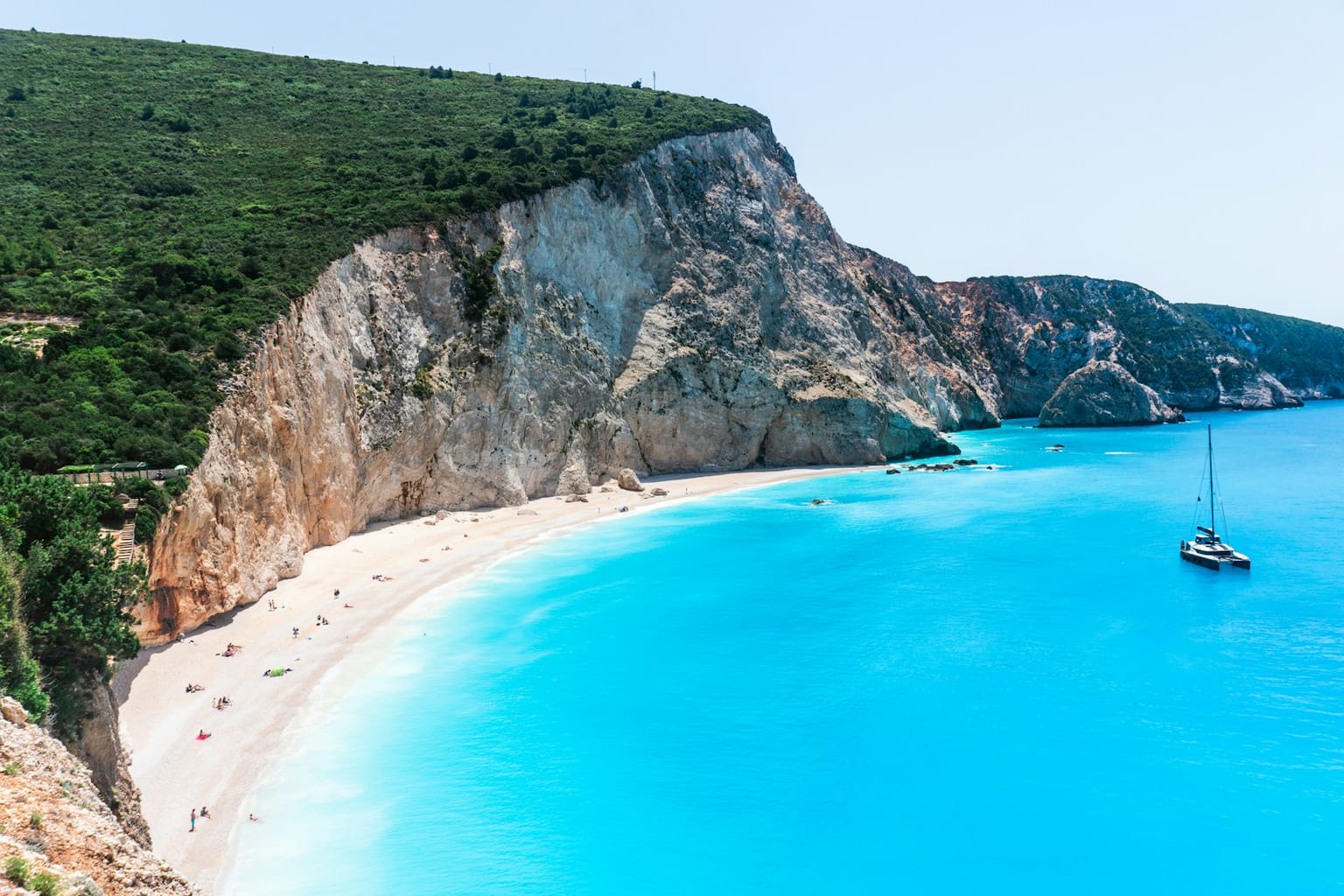
Lefkada makes the list for one stretch of coast. The west side of the island is white limestone cliffs dropping into water of an almost artificial blue, and Egremni, Porto Katsiki, Kathisma and Milos beach are the places the color photographs come from. Kathisma is the easy one, with road access, sunbeds and bars. Egremni and Porto Katsiki are the spectacular ones, reached down long staircases or by boat.
The catch is the steps (hundreds of them at Egremni), afternoon wind, and the fact that these are pebble and coarse-sand beaches rather than soft sand. Base yourself in Agios Nikitas or Vasiliki on the west coast, or in Nidri if you want boat trips to the beaches and the satellite islands.
Crete
Crete is so big that it could fill this list on its own. Elafonisi in the southwest is pink-tinged sand and a lagoon you can wade across; Balos is a turquoise lagoon reached by a rough track or a boat from Kissamos; Falassarna is a long sandy sweep facing west into the sunset; Preveli has a palm-lined river mouth; Vai has a palm forest behind the sand. That is just the headline list, and the south coast around Plakias and Loutro has dozens more.
The catch is distance. Chania to Elafonisi is a 90-minute drive each way, and the famous beaches are on opposite ends of a 260-kilometer island, so you cannot base once and see them all. Base yourself in Chania for the west, in Plakias or Rethymno for the south-central coast, and treat Vai as a separate eastern trip.
Karpathos
Karpathos is the connoisseur’s pick. Apella, a curve of white pebbles and sand under a pine-covered mountain, is regularly named the best beach in the Dodecanese, and Kyra Panagia, Achata and Ahata are all nearby on the same coast. The south is one long windswept beach at Afiartis that is world-class for kitesurfing. Because the island is far from everything and has only a small airport, the beaches are half empty even in August.
The catch is getting there: the airport has limited direct European flights, and the ferry from Rhodes takes a full day. Roads to the east-coast beaches are steep and slow. Base yourself in Pigadia, the main town, for choice of tavernas, or in Amoopi for a quieter beach-side stay.
Kefalonia
Kefalonia has Myrtos, which is on every list of the best beaches in Europe and looks the part from the viewpoint above. Antisamos is the more relaxed alternative, with trees behind and calmer water. Petani on the Paliki peninsula is a quieter version of Myrtos, and Xi has strange rust-colored sand and clay cliffs that people smear on themselves.
The catch is that Myrtos itself is large pebbles with strong waves and no shade, so it photographs better than it swims. Base yourself in Argostoli for a central position, or in Fiskardo or Assos for scenery and a longer drive to the beaches.
Zakynthos
Zakynthos is the family-friendly beach island of the Ionian. The south coast from Laganas to Gerakas is long, sandy and shallow, and Gerakas in particular is protected as a loggerhead turtle nesting site. Navagio, the shipwreck beach, is only reachable by boat and has been closed to landings since 2023 because of rockfall, but the boats still stop offshore and the view from the cliff platform above is still the reason most people come.
The catch is that Laganas is a British party resort, and the island’s best-known beach cannot be walked on. Base yourself in Vasilikos on the southeast peninsula for the best beaches and a quieter atmosphere, or in Zakynthos Town for a real Greek town.
How we chose
We weighted three things: the quality of the water and sand, the variety of beaches within an hour’s drive of a single base, and how crowded they get in July and August. We favored islands where you can spend a whole week on different beaches without repeating, and marked down islands whose best beaches are closed, inaccessible or dominated by one resort.
Islands to avoid for beaches
Santorini has dark volcanic sand that scorches by noon and its most photogenic beach, Red Beach, is often closed; go for the view, not the sand. Hydra has no real beaches at all, only rocky swimming platforms. Mykonos has excellent beaches but they are the most expensive and crowded in Greece, and sunbeds at Psarou or Nammos cost more than a hotel room elsewhere. Ikaria, Samos and Lesbos all have good beaches, but they are secondary to the hiking, hot springs and villages that people go for.
If beaches are only part of what you want, take our Greek island quiz and we will balance them against budget, nightlife and travel time. Or compare the details across all 25 island guides.
Frequently asked questions
Which Greek island has the clearest water?
Lefkada and Kefalonia in the Ionian have the most vivid blue water because of white limestone seabeds. In the Cyclades, Milos and Koufonisia are the clearest. Crete's Balos lagoon is the most famous single stretch.
Which Greek island has the best sandy beaches?
Naxos, for length and softness of sand; the west coast is almost entirely golden sand. Crete's Elafonisi and Falassarna and Zakynthos's south coast are the other sandy standouts. Most Ionian beaches and much of Milos are pebble or coarse sand.
Which Greek island has the most beaches?
Crete, by a wide margin, simply because it is enormous. For an island you can actually cover in a week, Milos has around 70 named beaches in 150 square kilometers, which is the highest density in Greece.
Last updated 2026-09.