Best of
Best Greek Islands Without a Car
The best Greek islands without a car: Paros, Hydra, Skiathos, Naxos, Santorini, Sifnos and Mykonos, with bus and boat logistics and where to base.
The best Greek island without a car is Paros: a bus network that reaches every beach worth visiting, two towns you can walk end to end, and ferries that make day trips to Naxos and Antiparos a matter of buying a ticket. If you want to remove the question altogether, the runner-up is Hydra, where cars are banned by law and everything moves by foot, donkey or water taxi.
Quick answer
- Paros — frequent buses from Parikia to Naoussa, Golden Beach, Aliki and Lefkes; walkable towns; ferries as transport.
- Hydra — no cars at all, and a joy because of it; swim spots reached on foot or by water taxi.
- Skiathos — one main road, one bus, 26 numbered stops ending at Koukounaries.
- Naxos — buses from Chora down the beach strip to Plaka every half hour in summer.
- Santorini — every route runs through the Fira bus station, including the airport and the port.
- Sifnos — a small island with a surprisingly complete bus network centered on Apollonia.
- Mykonos — two bus stations plus caiques that hop between the south-coast beaches.
Paros
Paros wins because its geography suits public transport. Parikia, the port, is the hub; buses leave from beside the ferry quay to Naoussa roughly every half hour in summer, and other routes fan out to Golden Beach and Drios on the east coast, Aliki and Pounda in the south, and the hill village of Lefkes. From Pounda a ferry shuttles across to Antiparos every half hour, and from Parikia you can be on Naxos in under an hour.
The catch is that some of the best small beaches, Kolymbithres and Monastiri in Naoussa Bay, are easier by the little boats from Naoussa harbor than by bus, and the buses thin out after early October. Base yourself in Parikia if you want the most connections, or Naoussa if you are happy with one bus route and a lot of walking.
Hydra
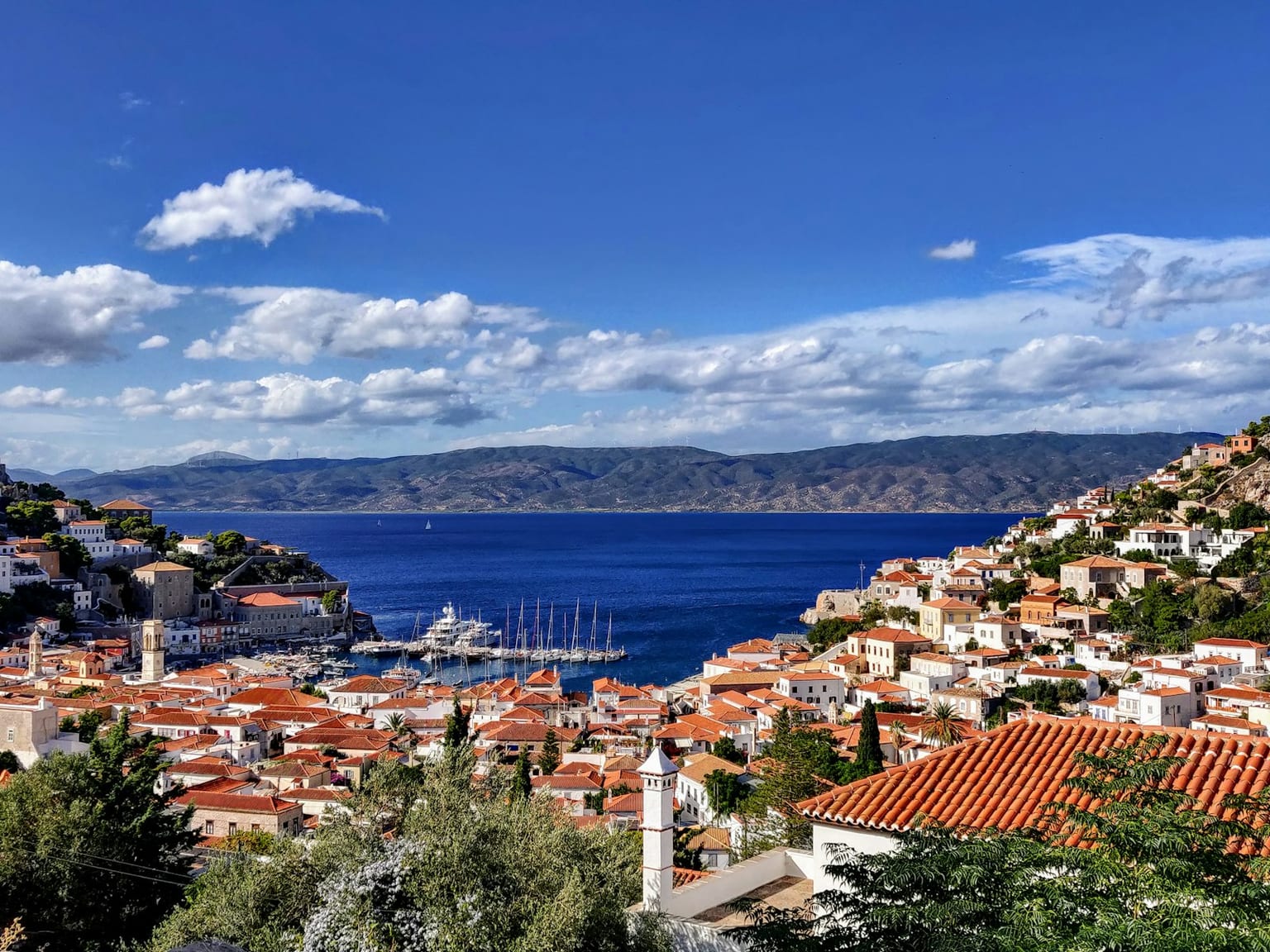
Hydra is the only island on this list where the question is moot. There are no cars, no scooters, and no roads to speak of; luggage goes up from the ferry on a donkey or a handcart. The coastal path west of the harbor reaches swimming spots at Kamini and Vlychos in 20 and 40 minutes on foot. Water taxis cover the same run and continue to Bisti and Agios Nikolaos farther out.
The catch is that Hydra has rock platforms rather than sandy beaches, and it is not cheap, because Athenians have been coming for weekends since the 1960s. It is under two hours from Piraeus by fast ferry, which makes it the perfect two-night add-on to Athens rather than a week-long base. Stay in the harbor town; there is nowhere else.
Skiathos
Skiathos was practically designed for a car-free holiday. The island has one main road running west from Skiathos Town along the south coast, and one bus runs along it with 26 numbered stops, ending at Koukounaries, the big pine-backed sandy beach. Every beach that matters, from Megali Ammos to Vromolimnos to Troulos, is a numbered stop, and in summer the bus runs late.
The catch is that the north-coast beaches, Lalaria and Kastro, are reachable only by boat trip from the old port, and that the bus in August is standing room only by mid-morning. Base yourself in Skiathos Town for the evenings, or near Troulos if you want the beaches on your doorstep.
Naxos
Naxos has the best beaches in the Cyclades and a bus that runs to them. From the stop by the port in Chora, buses head down the west coast to Agios Prokopios, Agia Anna and Plaka every 30 minutes or so in summer, and others go to the mountain villages of Halki, Filoti and Apeiranthos and to Apollonas in the north.
The catch is that the island is large, and the villages and the south-coast beaches beyond Plaka get one or two buses a day, so serious exploring is a rental-car job. Base yourself in Chora, which is the hub for everything, or at Agios Prokopios or Agia Anna, both on the frequent line.
Santorini
Santorini is easier without a car than its reputation suggests. Every KTEL bus route starts and ends at the station in Fira, with services to Oia, Imerovigli, Kamari, Perissa, Akrotiri, the airport and the Athinios ferry port. The caldera path from Fira through Imerovigli to Oia is one of the best walks in Greece, about three hours.
The catch is that the Fira station is chaotic in July and August, buses to Oia fill up before sunset, and the last bus back can be earlier than you want. Base yourself in Fira or Firostefani, which give you the walk and the bus hub, rather than in Oia at the end of the line.
Sifnos
Sifnos punches above its size on buses. The port, Kamares, connects to Apollonia, the inland capital, and from there routes run to Kastro on the east coast, Platis Gialos and Faros in the south, Vathi in the southwest and Cheronissos in the north. The island is also crossed by well-marked walking trails, so the combination of bus out and walk back is the classic Sifnos day.
The catch is that services drop to a few a day outside July and August, and there is no airport, so you arrive by ferry from Piraeus, two and a half hours on a fast boat or five on a slow one. Base yourself in Apollonia for connections, or Platis Gialos for the beach.
Mykonos
Mykonos is included because the transport is genuinely good, whatever you think of the prices. Buses leave from two stations, Fabrika on the south side of town and the Old Port on the north, to Ornos, Platis Gialos, Paradise, Kalafatis, Ano Mera and the airport. From Platis Gialos and Ornos, caiques run along the south coast to Paraga, Paradise, Super Paradise, Agrari and Elia, which is the pleasant way to beach-hop.
The catch is that the taxis are famously scarce, the buses stop earlier than the nightlife, and the north-coast beaches like Agios Sostis are effectively car-only. Base yourself in town or in Ornos, which is on both the bus and the boat routes.
How we chose
We looked at three things: whether the main beaches and villages are on a bus or boat route that runs at least hourly in summer, whether the town you sleep in is walkable, and whether the island’s best sights are reachable without a vehicle at all. Boats counted; taxis did not, because on most islands you cannot get one. Transport notes for every island are in all 25 island guides.
Islands to avoid without a car
Crete, Rhodes and Corfu are large enough to have real bus networks, but the reason to go is the coastline and the interior, and both need wheels. Lefkada, Kefalonia and Zakynthos have their best beaches at the end of long mountain roads with one bus a day at most. Karpathos, Ikaria, Andros and Amorgos are mountainous islands where the villages are the point and the buses are timed for locals, not visitors. Milos is usually done by ATV or car because the beaches are spread around the whole island.
If you know you will not be driving, the island quiz lets you say so up front and only matches you with islands that work on foot, by bus and by boat.
Frequently asked questions
Which Greek islands have no cars at all?
Hydra is the famous one, and the only sizeable island where vehicles are banned. Spetses restricts cars for non-residents, and a few tiny islands such as Halki near Rhodes and Antiparos town are effectively car-free in the center. Most other islands, including Folegandros and Samos, allow cars but have walkable main towns.
Can you rely on buses on the Greek islands?
On the islands above, yes, in July and August. Timetables change monthly and services drop sharply in shoulder season. Always check the last bus back before you commit to a beach.
Is it worth renting a scooter instead?
Only with a full motorcycle license, which rental companies now check, and only if you are already a confident rider. Island roads are steep and gravelly. An ATV is the usual compromise, but it needs a car license and is slow and loud.
Last updated 2026-09.